
In short
Linewidth is the spectral width of the emission. Coherence length is how far the light stays correlated with itself. Narrower line means longer coherence.
The conversion between them depends on lineshape and on which definition of coherence length you use. Always state the convention.
Most applications need far less than the narrowest source on the market. Buy the linewidth your measurement uses.
Linewidth appears on every laser datasheet, sometimes in megahertz, sometimes in picometres, occasionally in nanometres. The units look unrelated and the numbers are hard to compare. This article converts between them, says which convention each figure assumes, and sets out what each range is actually good for.
What linewidth means
No laser emits at exactly one frequency. The output occupies a narrow band, and linewidth is the width of that band, conventionally measured at half its peak height. A perfectly monochromatic source would have zero linewidth and infinite coherence. Real sources sit somewhere between a few kilohertz and several nanometres.
Two mechanisms set it. Fundamental broadening from spontaneous emission puts a floor on any laser. Technical broadening from current noise, temperature fluctuation and mechanical vibration sits on top and usually dominates by orders of magnitude. That second part is what stabilization addresses, and it is also why a measured linewidth depends on how long you measure: frequency noise that looks like drift over a second looks like width over a minute.
MHz, pm and nm: how to convert
Δλ ≈ λ² · Δν / c
Valid for narrow lines, that is small relative bandwidth
The same frequency linewidth corresponds to a larger wavelength spread at longer wavelengths. A 10 MHz line is 0.013 pm at 633 nm but 0.021 pm at 785 nm.
| Linewidth | at 405 nm | at 633 nm | at 785 nm | Coherence length* |
|---|---|---|---|---|
| 10 MHz | 0.005 pm | 0.013 pm | 0.021 pm | approx. 10 m |
| 100 MHz | 0.055 pm | 0.13 pm | 0.21 pm | approx. 1 m |
| 1 GHz | 0.55 pm | 1.3 pm | 2.1 pm | approx. 10 cm |
| 10 GHz | 5.5 pm | 13 pm | 21 pm | approx. 1 cm |
| 1 nm (at 785 nm) | – | – | 490 GHz | < 1 mm |
*Coherence lengths calculated for a Lorentzian line with the 1/e definition, see the next section. Other conventions give values differing by a factor of around three.
Coherence length and its conventions
Coherence length is the optical path difference over which the light still interferes with itself usefully. It follows from linewidth, but the exact relation depends on the lineshape and on where you decide the coherence has ended.
Lc ≈ c / (π · Δν)
Lorentzian line, field correlation fallen to 1/e · 10 MHz gives about 9.5 m
Which formula you will also see
The cruder rule L = c / Δν appears in many texts and gives roughly three times the value above. Neither is wrong, they answer slightly different questions. What matters is that a datasheet states which one it used, and that you do not compare a number from one convention against a number from the other.
Fringe contrast also does not vanish at a threshold. It decreases gradually as the path difference grows, so coherence length is a scale rather than a cliff edge.
For an interferometer the quantity that matters is the optical path difference between the arms, not the length of the setup. If a mirror moves, the path difference changes by twice the mechanical travel, because the light makes the trip in both directions.
How much do you actually need?
Orientation, not specification. The governing quantity is in the third column, and that is what you should calculate for your own setup.
| Application | Often sufficient | What actually governs it |
|---|---|---|
| Fluorescence excitation | almost anything | Absorption bands are tens of nm wide. Wavelength position and stability usually matter more than width |
| Raman, dispersive | any single mode diode | Spectrometer resolution, typically 0.5 to 5 cm⁻¹, which is far broader than any of these linewidths |
| Holography | often GHz class | Path difference between object and reference arm, not object depth |
| Interferometry | often below 10 MHz | Maximum optical path difference, remembering the factor of two for a moving mirror |
| Atomic and molecular spectroscopy | often below 1 MHz | Transition width, Doppler broadening and the method used |
| Plasma diagnostics by LIF | narrow and tunable | The lineshape itself is the measurement |
The first two rows are the ones worth internalising. For most fluorescence work and for ordinary dispersive Raman, linewidth is not the limiting element, and paying for a stabilized source buys a specification nothing in the measurement uses.
 When linewidth matters
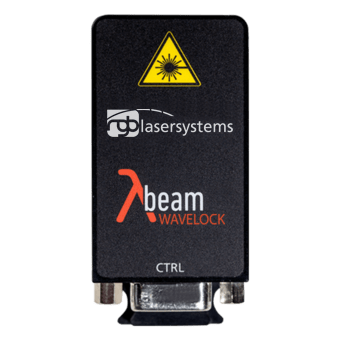
Lambda Beam Wavelock
Wavelength stabilized modules · linewidth and coherence length per variant in the datasheet
See specs
When linewidth matters
Lambda Beam Wavelock
Wavelength stabilized modules · linewidth and coherence length per variant in the datasheet
See specs
Single frequency, single mode, narrow linewidth
| Term | What it describes | What it does not say |
|---|---|---|
| Single transverse mode (TEM00) | Spatial beam profile, close to Gaussian | Nothing about the spectrum |
| Single longitudinal mode | One cavity mode oscillating at a given moment | Nothing about beam shape, and nothing about mode hops over time |
| Narrow linewidth | The numeric width of that mode | A source can be single mode and still comparatively broad |
Single longitudinal mode operation does not by itself guarantee freedom from mode hopping. A laser can run on one mode and still jump to a neighbouring one as temperature or current changes. If your measurement cannot tolerate that, look for an explicit mode-hop-free specification with the conditions it holds under, not just the words single frequency.
For interferometry you need stable single longitudinal mode operation. For focusing you need TEM00 and a stated M². For a spectrometer you need the numeric linewidth. Check all three separately.
Comparing datasheets
- Convert everything to frequency first. A supplier quoting picometres at 1064 nm and one quoting megahertz at 405 nm are not comparable at a glance.
- Check whether the figure is FWHM, and over what measurement time and with what method it was obtained. Measured linewidth of a real laser depends on both.
- Separate the spectral envelope from the single mode width. A multi-longitudinal-mode diode has an envelope spanning hundreds of GHz while each individual mode is far narrower. Datasheets do not always make clear which they mean.
- Treat stabilization claims as design dependent. A volume holographic grating or an external cavity reduces frequency noise and drift, but by how much is specific to the module and has to be stated with measurement conditions.
Linewidth is not wavelength stability
A module can legitimately quote a linewidth below 10 MHz and a wavelength stability of 0.015 nm at the same time. The first is the spectral width of the line, the second is how far its centre drifts over a stated period and temperature range. They are different specifications and neither implies the other.
Frequently asked questions
How do you calculate the linewidth of a laser?
You measure it rather than calculate it, usually by beating the laser against a reference or with a delayed self-heterodyne setup. Converting between frequency and wavelength uses Δλ ≈ λ²Δν/c. Coherence length follows from the linewidth once you fix a lineshape and a definition.
What does linewidth mean in practice?
It influences two things: the finest spectral detail that the source itself does not blur, and how far the light stays coherent. If your measurement depends on either, linewidth is a hard specification. If it depends on neither, it is a number you can mostly ignore.
What is the difference between linewidth and bandwidth?
Linewidth normally refers to a single emission line, measured at half maximum. Bandwidth is the broader term and can describe the total spectral span of a source including several modes. For a true single frequency laser the two coincide.
What is the typical linewidth of a diode laser?
It depends which quantity you mean. A free-running Fabry-Perot diode has a spectral envelope spanning hundreds of GHz, roughly a nanometre, while its individual longitudinal modes are much narrower. A DFB diode commonly reaches the low MHz range, though this is an example rather than a guaranteed property of the type. External stabilization reduces it further by an amount specific to the design.
Does narrower linewidth always mean better?
No. Narrower usually means more expensive, more temperature sensitive and more vulnerable to optical feedback. For fluorescence excitation and ordinary dispersive Raman it buys nothing measurable. Specify what the measurement uses.
Not sure which linewidth your setup needs?
Tell us the measurement, the optical path difference or spectrometer resolution you work with, and we will tell you where the requirement actually sits.