

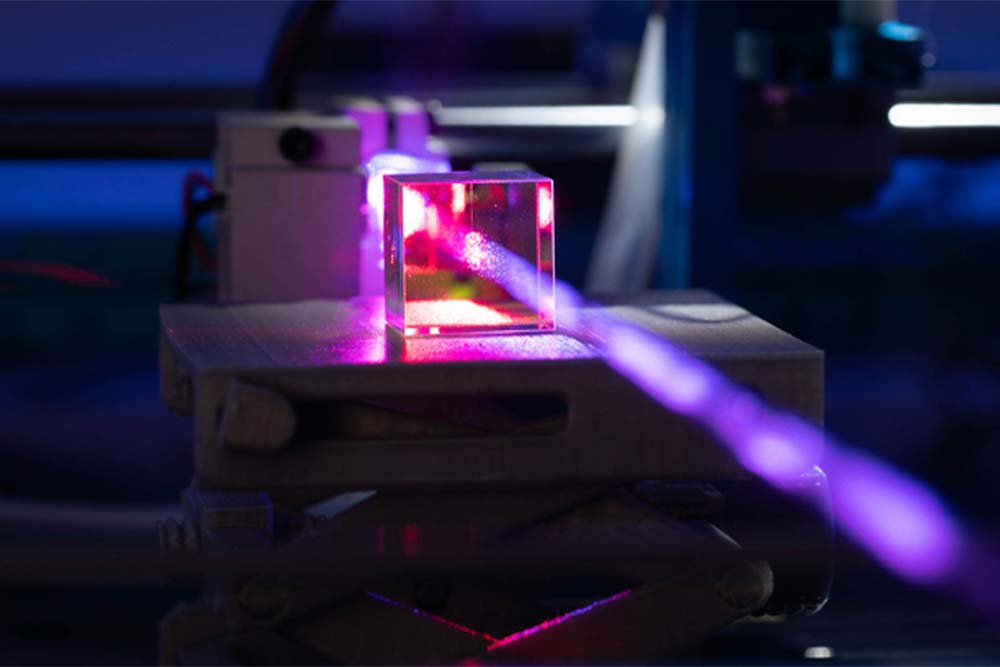
Raman laser for Raman spectroscopy
A Raman laser is a laser source where the amplification mechanism is stimulated Raman scattering, not stimulated electronic emission. Pump light is converted into lower frequency Stokes light, and the energy difference is set by a vibrational frequency of the Raman active medium.
The term Raman laser is used in two ways. It can refer to a true Raman gain device or a laser that is simply well suited as an excitation source for Raman spectroscopy. This distinction is important when comparing laser sources for Raman instruments, as ist affects parameters such as wavelength flexibility, linewidth, stability, complexibility and cost.
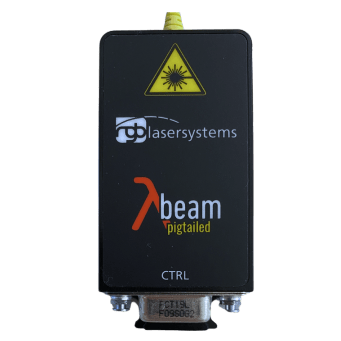
How a Raman laser generates new wavelengths
Stimulated Raman scattering starts from an inelastic interaction between light and vibrational modes in a material. A pump photon can be converted into a Stokes photon at a longer wavelength, and the presence of Stokes photons accelerates the conversion. Therefore the process can provide optical gain.
Because the frequency shift is linked to a material vibration, you can reach output wavelengths by selecting an appropriate pump wavelength, as long as both wavelengths lie within the transparency window and the optical intensity is high enough.
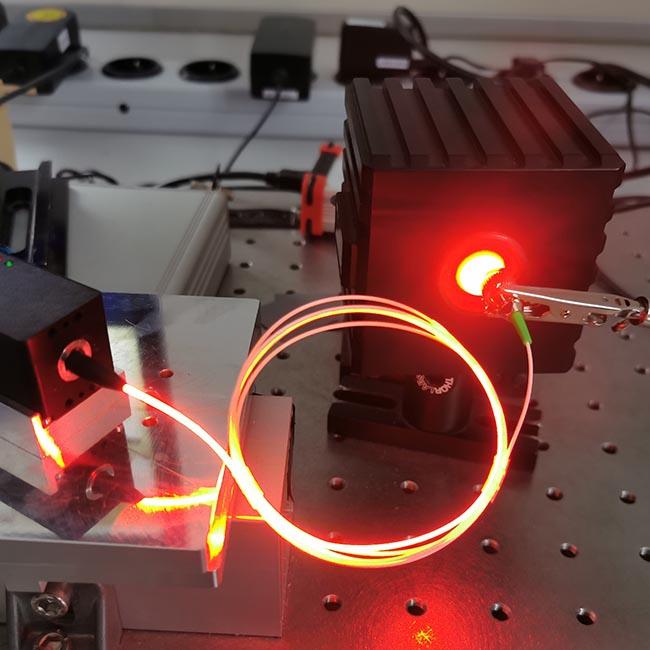
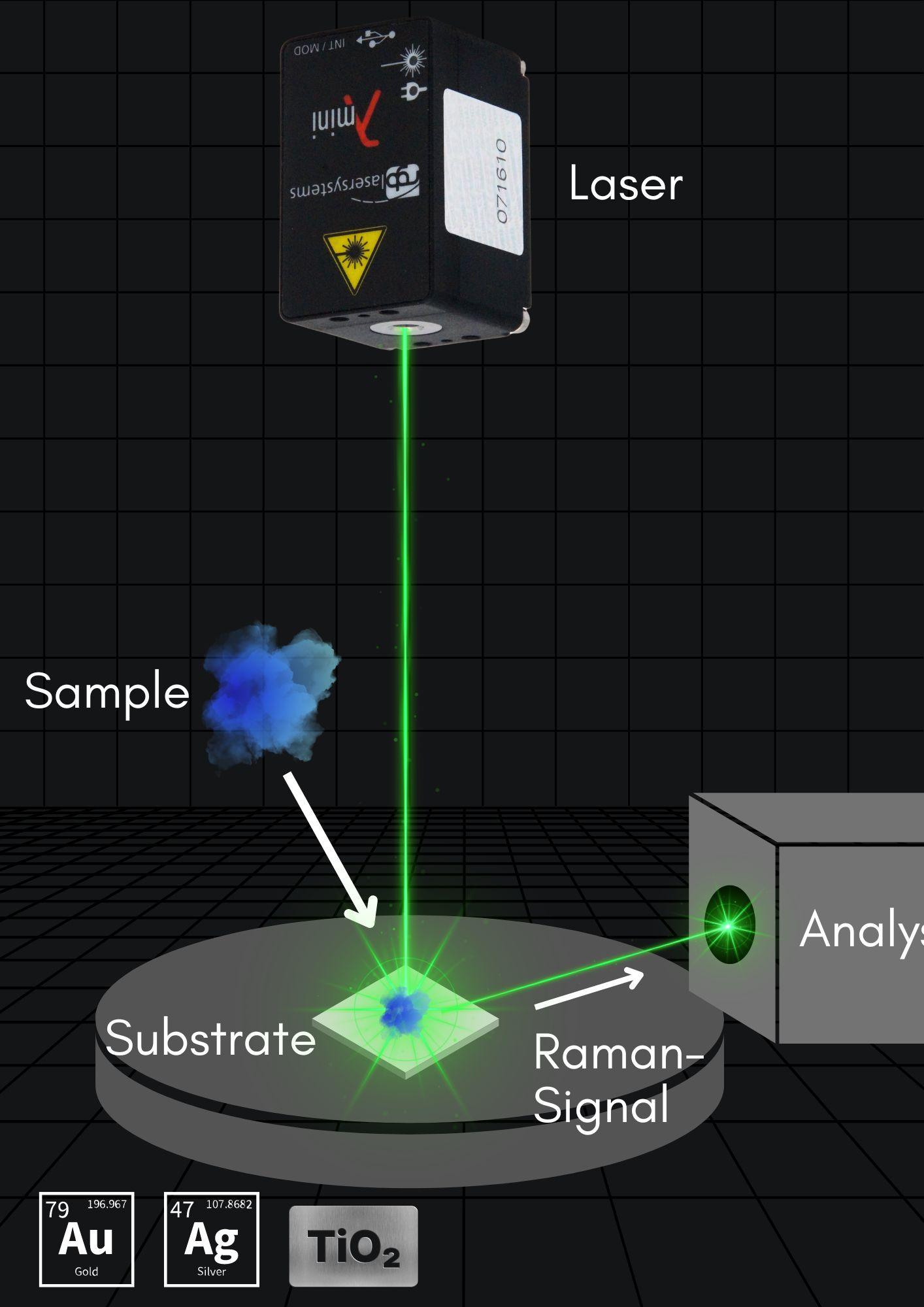
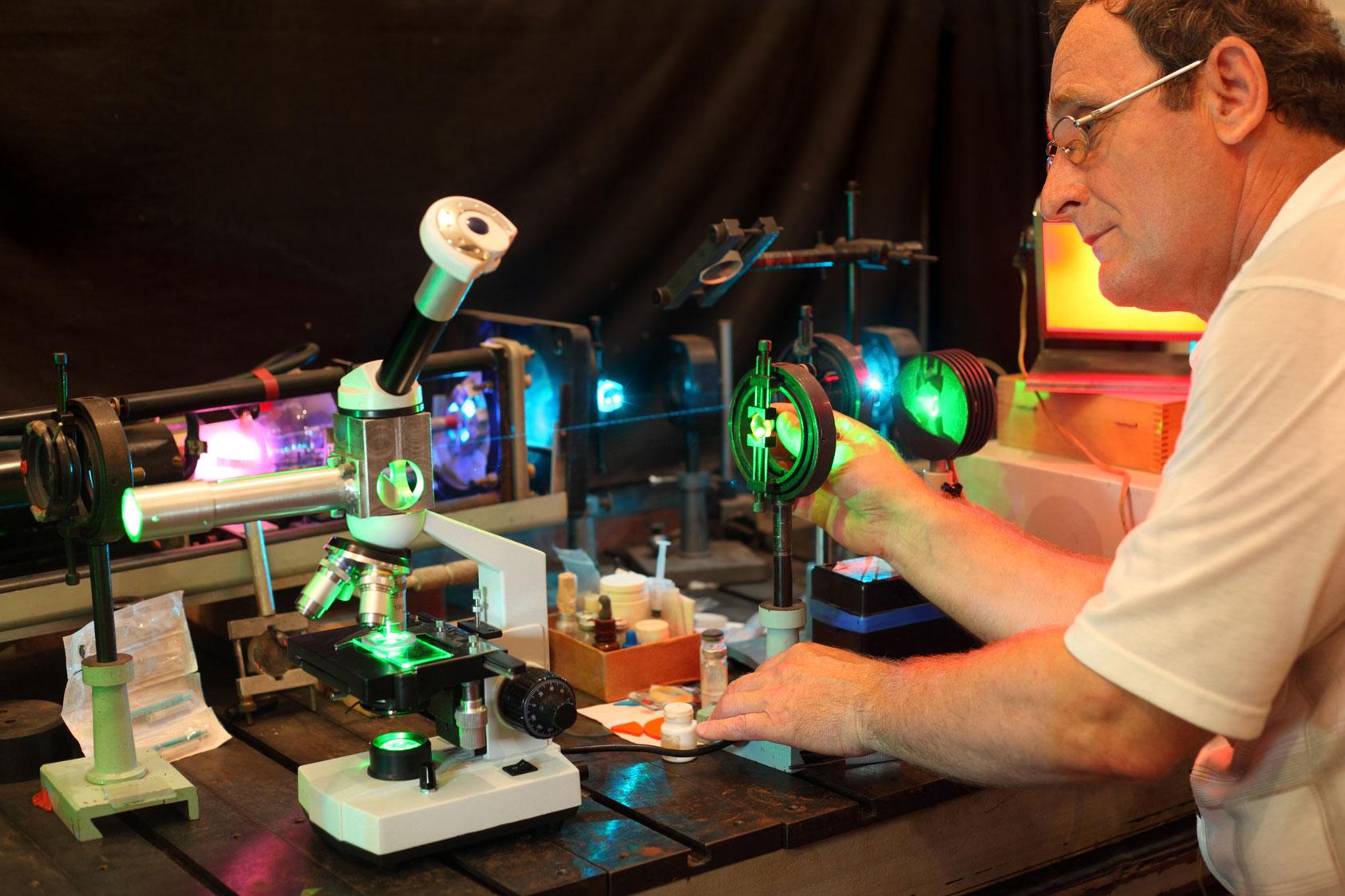
Architectures used for Raman conversion
Many Raman lasers use optical fiber as the gain medium, because long fiber length boosts interaction. Cascaded Raman fiber lasers often use nested pairs of fiber Bragg gratings to create multiple conversion steps. Light generated in one step pumps the next, which enables larger total wavelength shifts. In a Raman laser, feedback selects the Stokes order you want. Although designs vary, this architecture is practical for continuous wave output and compact packaging.
Other gain media for Raman conversion
Fiber is common, but it is not the only option for Raman conversion. Raman gain can be realized in bulk crystals, microcavities, liquids, gases, and waveguides. The right gain medium depends on wavelength range, thermal load, and how much shift you need. Compact resonators can raise intensity and reduce threshold, however they also demand precise alignment. On the one hand you can chase maximum efficiency. On the other hand you may prioritize stability and simplicity.
Why excitation quality matters in Raman spectroscopy
Raman features are often tiny compared to elastic Rayleigh scattering and background light. A noisy or drifting Raman laser can blur peaks and shift band positions. A narrow linewidth helps preserve spectral resolution, therefore your spectrometer can separate nearby lines. Wavelength drift during acquisition can deteriorate resolution and repeatability. Low noise, high stability, and clean polarization improve quantitative work, especially in mapping and chemometrics.
Linewidth, stability, and spectral purity targets
Start with Raman laser linewidth, because it sets a hard floor for achievable Raman resolution. Then look at wavelength stability and drift over time and temperature. Some guidance suggests drift should not exceed a few picometers during recording. Spectral purity matters too, because side modes and unwanted emission raise the baseline close to the laser line.
Choosing a wavelength for your sample
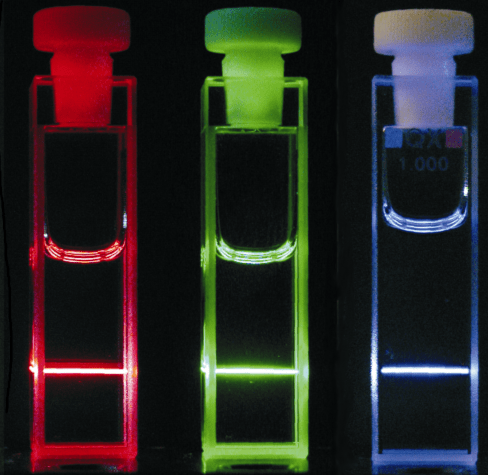
Raman laser wavelength choice is a tradeoff between signal strength and fluorescence. Shorter wavelengths can increase Raman scattering, but they can also trigger strong photoluminescence. Near infrared excitation often reduces fluorescence, however detector sensitivity and optics may change. Many systems use familiar wavelengths such as 405 nm, 532 nm, 785 nm, and 1064 nm. Match the wavelength to your sample and spectrometer range, because that is where performance lives.
Managing fluorescence and stray light
Rayleigh scattering is typically far stronger than Raman scattering. Therefore filters and clean optics are essential to protect weak Raman lines. Fluorescence can still dominate, so you may need a longer Raman laser wavelength or lower power. On the one hand you want more photons for better signal. On the other hand you must avoid heating and photodamage. Good stray light control also improves low wavenumber measurements close to the laser line.

Integration checklist for instruments
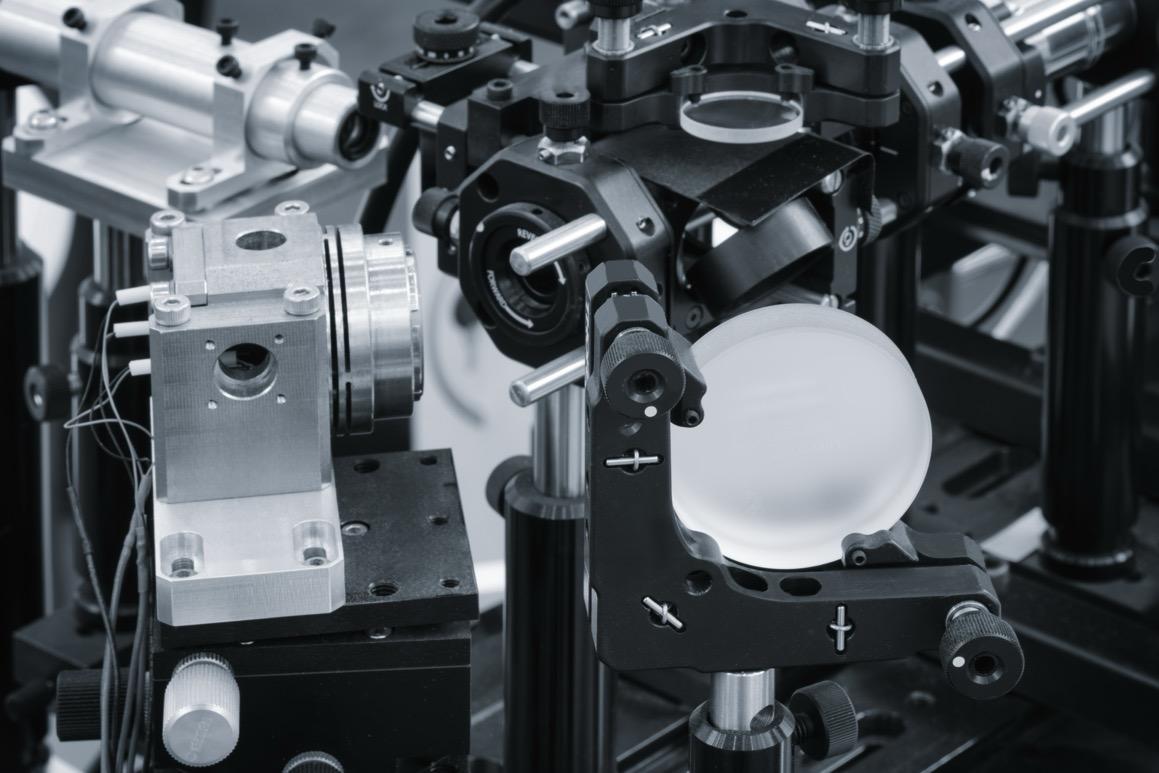
For OEM builds, a Raman laser must behave like a reliable component. Thermal control supports wavelength stability, because many laser technologies shift with temperature. Optical isolation protects against back reflections that can disturb single frequency behavior. Fiber delivery can simplify alignment and improve reproducibility across units. Control interfaces, modulation inputs, and interlocks support automation and safety. If integration feels effortless, your team can focus on spectroscopy, not debugging.
Specifying a Raman laser module for Raman systems
Define wavelength first, then set output power based on signal, sample limits, and optics losses. Specify Raman laser linewidth, wavelength stability, and allowed drift during a measurement. Add requirements for beam quality and polarization, because they affect coupling and scattering efficiency. State the delivery format, free space or fiber, and your modulation needs. Share duty cycle and ambient conditions, because thermal design follows from them. Clear specs reduce risk and speed up procurement.
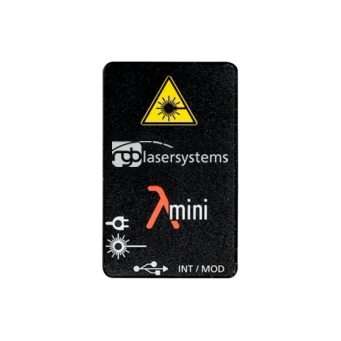
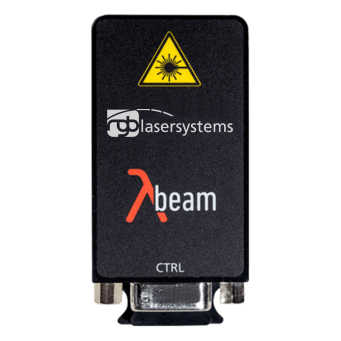
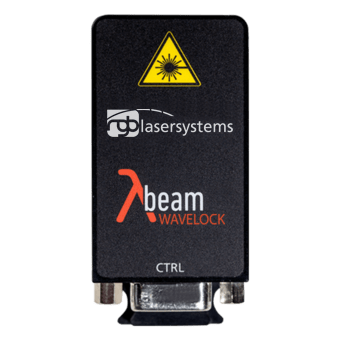
Lambda Product Lineup
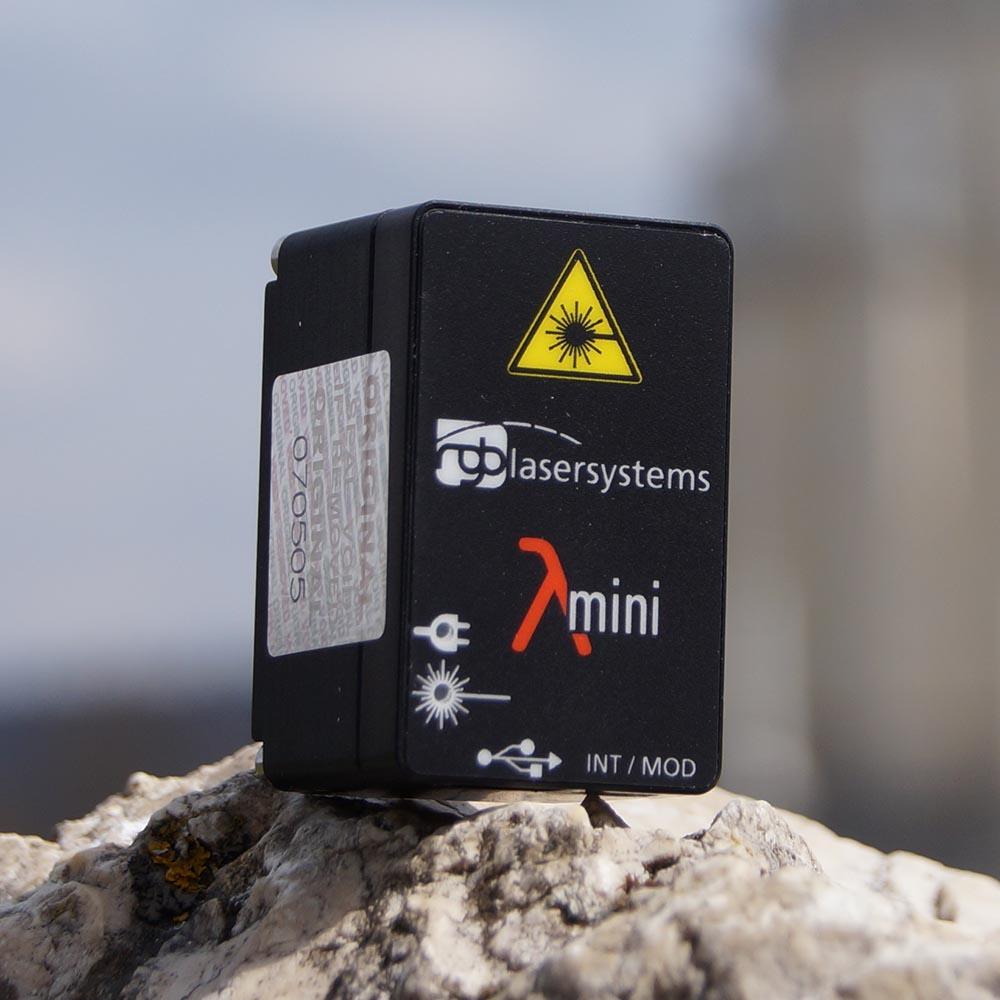
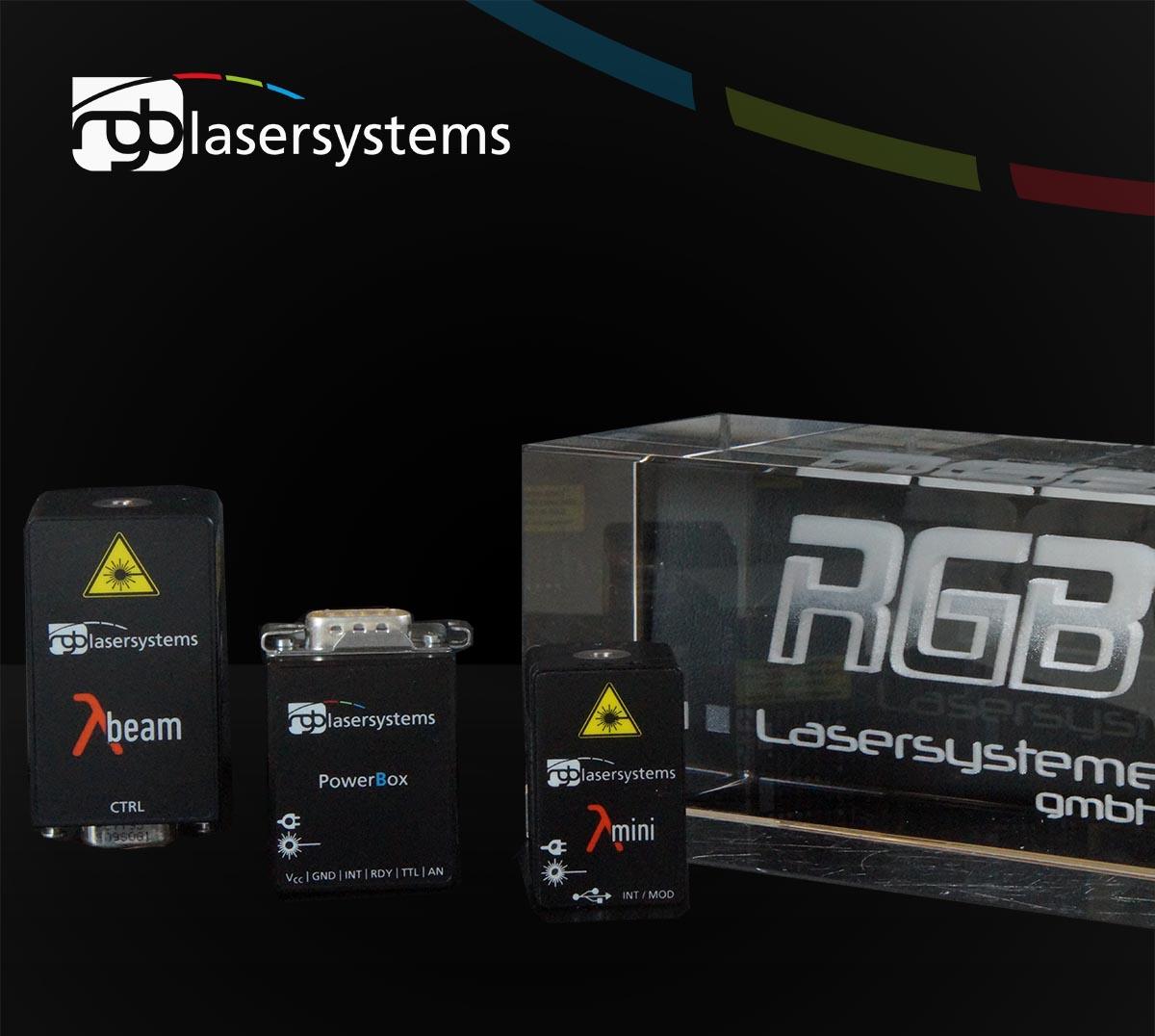
Our laser modules are being used in a large range of different applications including but not exclusive to Raman spectroscopy. Our products offer numerous advantages which you can find on our products page or in their respective datasheets from our downloads page.
RAMAN excitations Light- / Product- / Material-Analysis OEM / System Integration Research & Education Process Control & Monitoring Anti‑Counterfeiting Protection Bio‑ / Medical Applications
-
extraordinary high value to price ratio
-
precise creation and detection of light
-
free of charge control software with each laser
-
highly customizable module lineup
RGB Lasersystems – Lasers made in Germany for customers all over the world
18
years of experience
530+
satisfied customers
6
continents supplied to
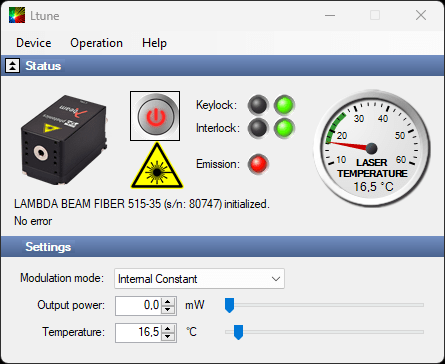
Monitor and control all essential device parameters with Ltune
Our software lets you choose between various modulation modes (if available), on demand services and calibration options.








Expertise for our customers
As one of the results of our many years of expertise and development work for various partners, our spectrometry business unit has been acquired by the American electrical group Broadcom.

What people are saying about us and our awesome products

Reliable and Precise
Reliable and Precise
“It´s amazing how reliable and precise these miniaturized Laser systems operate. Especially in such a challenging field as Raman spectroscopy, which is our main research topic.”
Reliable and Precise
“It´s amazing how reliable and precise these miniaturized Laser systems operate. Especially in such a challenging field as Raman spectroscopy, which is our main research topic.”
Reliable and precise
“It´s amazing how reliable and precise these miniaturized Laser systems operate. Especially in such a challenging field as Raman spectroscopy, which is our main research topic.”

Perfect customized light source
“With the Lambda Beam laser module RGB Lasersystems provided us a perfect customized wavelength-tunable light source for our photo-ionization setup.”
“It´s amazing how reliable and precise these miniaturized Laser systems operate. Especially in such a challenging field as Raman spectroscopy, which is our main research topic.”